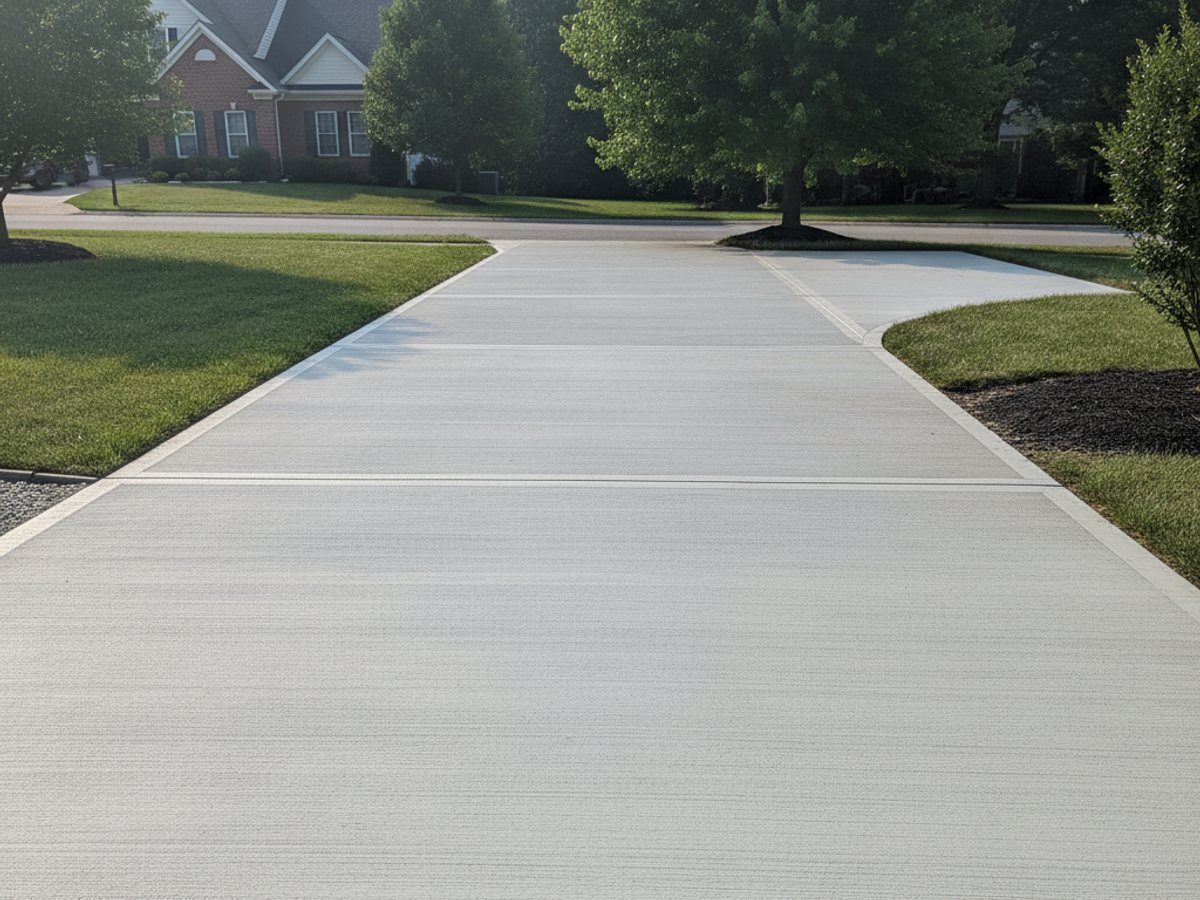
Homeowners usually ask this question backwards. They want to know what month is best, when the real answer is about temperature, ground moisture, and how fast the county can get an inspector to your address. In Silver Spring those three things line up best in two windows a year, and for reasons worth understanding before you pick a date.
Concrete cures on a schedule set by chemistry, not by you
Fresh concrete doesn't dry, it hydrates. Water and cement react and that reaction gives off heat and builds strength over roughly 28 days, with the first 72 hours doing the most important work. That reaction wants to happen somewhere between 50°F and 90°F. Below 50°F it slows down a lot. Below freezing it can stop entirely, and if water inside the slab freezes before the mix has gained enough strength, you get surface scaling and a slab that never hits its design strength no matter how long you wait after that.
Above 90°F, the opposite problem shows up. The surface dries out faster than the slab underneath can bleed water to it, and you end up with plastic shrinkage cracks, thin hairline cracks that appear within the first few hours while the crew is still finishing the surface. Maryland's summer humidity actually helps here, slower evaporation than a dry climate like Arizona would see at the same temperature, but a 95°F day in August with direct sun on a driveway pour still moves fast and needs cold water in the mix, shade cloth, or an early morning start.
What winter actually does to a slab here
Silver Spring sits in a part of Maryland where the ground freezes and thaws repeatedly all winter rather than freezing solid and staying that way. It's common for the temperature to cross 32°F forty or more times between December and March. That matters for two separate reasons. For a driveway or patio slab, repeated freeze-thaw cycling is what eventually pops the surface off an unsealed slab, especially one that's been hit with de-icing salt, which is why sealing every two to three years matters more here than in a dry climate. For a footing or foundation, we have to get below the frost line, which in this part of Montgomery County runs around 30 inches deep. Pour a footing shallower than that and the ground underneath can heave when it freezes, cracking what's sitting on top of it.
None of that means winter work is impossible. It means a cold-weather pour needs insulated blankets over the slab for the first few days, hot water in the mix, and a different set of forms than a June pour would use. It's doable. It costs more and takes more babysitting, and we'll tell you that up front rather than let a client assume a January patio pour is the same job as a May one.
Clay soil and spring rain
A lot of Silver Spring, especially the older lots around Woodside, Four Corners, and the neighborhoods closer to the DC line, sits on clay-heavy soil left over from the Piedmont's old weathered rock. Clay swells when it's wet and shrinks when it dries out, sometimes by an inch or more across a season. Pour a slab on clay that's still saturated from a wet March and you're pouring on ground that's going to shrink under it later, which is a direct path to a slab that settles unevenly or cracks at a joint we didn't expect.
Spring in this area brings steady rain through April and May, plus the occasional remnant of a tropical system by September. We want the subgrade compacted and tested dry enough to hold its shape, not muddy, before we ever set a form. That's one reason late spring pours sometimes get pushed a week or two. It's not us dragging our feet, it's waiting for the ground to stop acting like a sponge.
Why the shoulder months win
Put the temperature chemistry and the soil behavior together and you get the same answer most concrete contractors in this part of Maryland will give you: mid-April through June, and again September into October, are the two windows where the air temperature, the ground moisture, and the drying rate all cooperate at once. You're clear of hard freezes, you're usually past the worst of the spring saturation, and you're ahead of the August heat that forces an early morning start just to keep plastic shrinkage cracking off a freshly poured driveway.
July and August aren't off the table, they just take more planning, cold mix water, and a start time before 7am. December through February isn't off the table either, it just needs blankets, hot water, and patience. We've poured in both, and both of them work fine when the crew accounts for it.
Permits and the inspection calendar
Montgomery County's Department of Permitting Services issues the permits for most slab work here, and depending on the job that can mean a setback check against your property line, a footing inspection before concrete goes in, and in some neighborhoods an HOA sign-off on top of the county's own review. The inspection side is where the calendar actually bites people. Spring and early fall are the busiest months for every concrete contractor in the county, which means inspectors are busiest too. Book a footing inspection for a late May pour and you may be waiting longer for a time slot than you would in February, when almost nobody's pouring and the inspector's schedule is wide open.
If you're planning a driveway, a patio, a new slab foundation, or a repair and you want to actually land in one of the good windows, the time to call is six to eight weeks ahead, not the week you want the crew on site. Top Notch Concrete can walk the site, check the drainage and the soil, and tell you straight whether your date lines up with what the ground and the calendar are going to allow.